

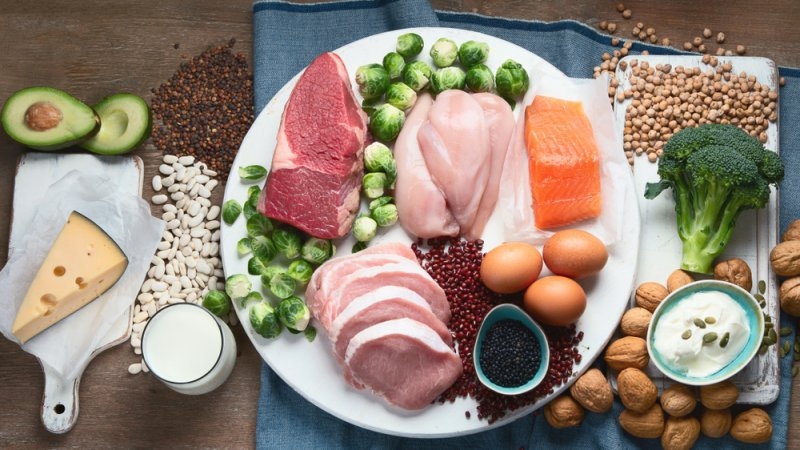
Protein is a vital nutrient that helps to support muscle building, repair tissues, make hormones, and much more. But your daily protein intake doesn't need to be the same as everyone else's.
Your body weight, age, activity levels, muscle mass, and objectives for your health can all play a part in deciding what your protein intake per day should be.
How much protein is enough depends on the person, not a one-size-fits-all number. "On average, 1.2 to 1.6 grams of protein per kilogram of body weight per day can be a good range for most adults," Cleveland Clinic says, "but there can be variations for each individual." The minimum of 0.8 grams per kilogram of body weight per day, which is the conventional advice to ward off deficiency, isn't necessarily optimal.
A person who weighs 150 pounds (68 kg) is eating at 1.2 grams/kilogram body weight, so 82 grams of protein per day. At 1.6 grams/kilogram, they would get about 109 grams of protein per day. This illustrates why some people find that protein consumption by body weight may be more useful than selecting the same protein consumption per day.
For instance, here's a simple way to get about finding out how much daily protein your body needs: convert your pounds to kilograms. You can easily do this by dividing your pounds by 2.205. From there, just multiply that kilogram value by the amount of protein you're interested in.
Simple estimates for people who are active: Most adults can use a calculation that multiplies their body weight in kilograms by between 1.2 and 1.6. This is just an estimate. It is not medical advice, and your protein needs per day may be higher or lower, based on your activity level, age, muscle mass, weight goals, or health.
Using body weight as a measure of protein consumption is an easy method to estimate grams of protein consumed per day. A person who weighs more will have a greater protein target compared to the same grams-per-kilogram formula.
Here are some examples of protein intake by body weight with a range of 1.2 to 1.6 g/kg:
Keep in mind that these numbers should be treated as guidelines, not daily protein requirements. A person's protein needs per day may fluctuate depending on their level of physical activity, age, muscle mass, calorie intake, etc.
Protein supplies the amino acids your muscles require for maintenance and repair, particularly when you're working out consistently or striving to hold onto muscle while losing weight.
So, how much protein per day to maintain muscle is not the only factor you need to consider; so does physical activity. Your muscles will respond to resistance training and maintain their strength, and protein will provide the amino acids needed to repair and maintain those muscle tissues.
This is especially true for the aging population, as muscle mass decreases with time. According to Stanford Medicine, adults over age 40 and those purposely reducing calories might want to boost their protein intake per day a little higher than the minimum.
Losing fat and lean tissue during weight loss. Protein consumption on a calorie-controlled diet may help to prevent lean tissue loss when combined with resistance exercise. The amount of protein you need to consume each day will still depend on the individual.
How to Increase Protein Intake (Without Very High Protein Consumption): Instead of just drastically increasing your protein intake, it may be more helpful to substitute some of your lower-protein foods for more nutritious ones.
Getting your required daily protein doesn't mean you have to turn to protein powders or other highly processed protein foods. Many protein-rich foods can be included in your diet.
For example, you could have some eggs, yogurt, and nuts for breakfast, plus fish or chicken for lunch, and beans, lentils, or tofu for dinner. Or you could include cottage cheese, nuts, tofu, chicken, and fish in your eating plan for the whole day.
Plant-based protein sources may be especially helpful since beans, lentils, and whole grains also contain fiber. "It really is not about a protein-centric approach," says Stanford Medicine. "It's about a balanced diet."
How much protein you need can also vary depending on your lifestyle and physical demands. A person who is physically active may require more protein than a person with a predominantly sedentary lifestyle. Those who are resistance training may also be more conscious of their protein consumption because they are challenging their muscles more often.
If you're wondering, “How much protein should I eat?” based on your weight, body weight is a good place to begin. Convert the lb to kg and then multiply by an appropriate protein goal. For most adults, 1.2–1.6 g/kg will be a manageable range.
But the simple answer to how much protein I need per day doesn't depend on my weight. Your activity level, your age, your muscle mass, your weight-loss goals, and your health status all need to be taken into account in terms of “how much protein do I need based on my weight per day?”
Knowing the ideal daily protein amount is not a matter of reaching the highest value; it is a matter of fulfilling your personal requirements. Although body weight can be a good starting point for calculating your daily intake of protein, other factors may affect that amount.
You may even be able to get your daily recommended protein intake from a healthy diet that includes eggs, dairy, fish, chicken, beans, lentils, soy-based foods, nuts, seeds, and whole grains. By learning how to figure out your daily protein needs and taking the big picture of your eating habits and lifestyle into account, you can build a more realistic plan to hit your daily protein target.
Yes; however, consuming protein every day can naturally differ. You do not have to eat the same amount of grams of protein each and every day. Focusing on your general eating routine can be easier than worrying about minor variations from day to day.
But the more you exercise, the more protein might matter. Body muscle, blood cells, and other bodily tissues require protein for repair and maintenance. Resistance training can be very demanding on body tissue. But in addition to training, protein doesn't substitute for calories, sleep, or nutrition.
Not necessarily. Don't eliminate vegetables, fruits, whole grains, or healthy fats just to add more protein to your diet. A healthy, well-rounded diet includes fiber, vitamins, minerals, and other nutrients that many protein foods don't contain.
No. Body weight helps determine the initial target for your daily amount of protein, but that is not the only factor. Age, activity levels, muscle mass, weight goals, and some health conditions may all affect how much protein you need.
Whey protein shakes don't have to be essential. Some people get enough protein from regular food such as dairy, eggs, fish, nuts, seeds, beans, lentils, tofu, and poultry. Use supplements if it's convenient, but it's not something you'll necessarily need.
This content was created by AI